
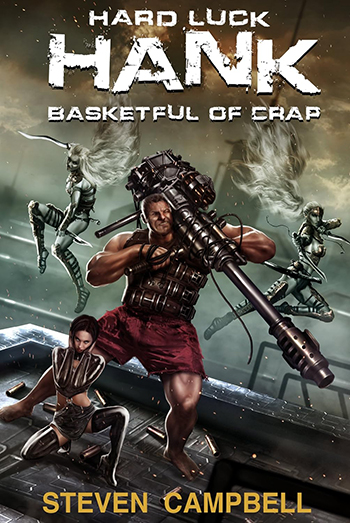
Hard Luck Hank: Basketful of Crap (Steven Campbell, Kindle eBook)
Here is a confession I need to make about myself: I suck at piecing together clues in a story to solve the big mystery before it's revealed. Whenever I try I always get it wrong so for the most part I take my seat, let the author steer the bus, watch the view out the window, then look back on the trip once it's over instead of spending the trip speculating on where it's going. You might call it a cowardly way to take things, but for most stories it's probably a healthier way to take things. I mean, how many videos speculating about what was in Eren Jaeger's basement popped up when Attack on Titan first came out? And what worth do those videos have after we learned it was a book and some photos?
I bring this up because this book is a perfect example of why I don't bother trying to solve mysteries. Not as much as when HBO's Game of Thrones would actively change plot reveals when people on forums correctly predicted the answer, rendering all that foreshadowing moot, but maybe on the level of Harry Potter and the Sorcerer's Stone making you think Snape was the mastermind behind the disasters befalling Hogwarts only for it to be Quirrel.
Because it's been nearly a decade since I read Screw the Galaxy, I don't remember a lot about it. I remember the guy who could alter reality when he got high, and Hank meeting the giant alien prince in a planet-sized spaceship at the end. Fortunately Basketful of Crap doesn't require you to remember or have even read the first book, being its own self-contained sci-fi mystery story as Hank investigates the connection between a Navy weapon that's gone missing, a pair of assassin sisters, and a man parading around in his birthday suit hiring Hank to take out rival crime rings.
It's a fine enough read, but as you probably guessed from my introductory paragraphs, the big ending twist left me feeling unsatisfied. A major plot point in this mystery is the portals used by the Navy to warp around the galaxy. Living beings need special protection, usually in the form of specially shielded transport vessel, to use or even get anywhere near those portals without being turned into strawberry jam, but when it's discovered somebody whose body is resilient enough would be able to get close to the portal and maybe even travel through it, Hank's journalist friend keeps asking him and by extension us, "Who's resilient enough to use a portal, and why would they want to use their own in secret instead of the ones the Navy runs?"
It's because the big bad wants to supply everyone with weapons and near-invincible giants in an attempt to start a galaxy-spanning way. And why does the big bad want to supply everyone with weapons and near-invincible giants in an attempt to start a galaxy-spanning war?
Because he was bored and thought it'd be funny. In other words, he's Emperor Zizzy Ballooba from MDK2.
I went back and read my Quickie of Screw the Galaxy (man, I hate looking at my old shit) and I basically had the same feelings towards it: it was a fun little read until the ending flipped the table right when you thought you had everything figured out. I don't recall Screw the Galaxy feeling like a "Lacking," though, guess I'm getting soft in my old age. And what the fuck was I talking about with "Yeah, there's a guy who can change reality when he snorts some nose candy, but this book isn't as zany as the cover would lead you to believe"??
Rating: 
The Cat Who Saved Books (Written by Sosuke Natsukawa, Translated by Louis Heal Kawai)
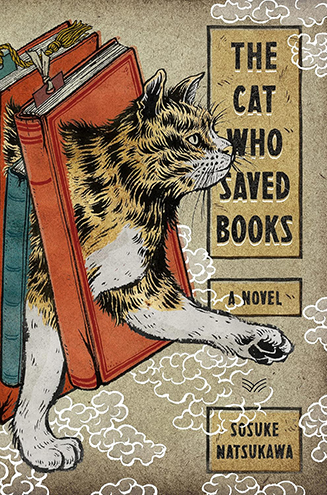
A phrase that comes up a lot in this is "books have tremendous power." What this power is revealed to be applies to all art, and is something to consider with the rise of AI. And despite being a book about books, the story plays out like a video game: Rintaro and his talking cat go through three dungeons and beats their bosses (three men with misguided ways of showing their passion for books), and when you think the job is done the final boss suddenly appears on the map.
And it is weird to read a book that takes place in Japan where characters with Japanese names bang on about the works of Shakespeare and The Chronicles of Narnia and The Grapes of Wrath. Yeah, they say these being the Japanese translations and I get it, they had to use more regionally recognizable books in the English translation because the only Japanese books most English readers have a chance of recognizing are the works of Haruki Murakami. It's still just... weird. Also, the "final boss" is a book itself, which manifests as a woman in a black dress. The story never spells out what book she is but when she describes herself (that she's two-thousand years old and the best selling book of all time), you know the answer and I'm curious if she was supposed to be the same book in the original Japanese.
Rating: 